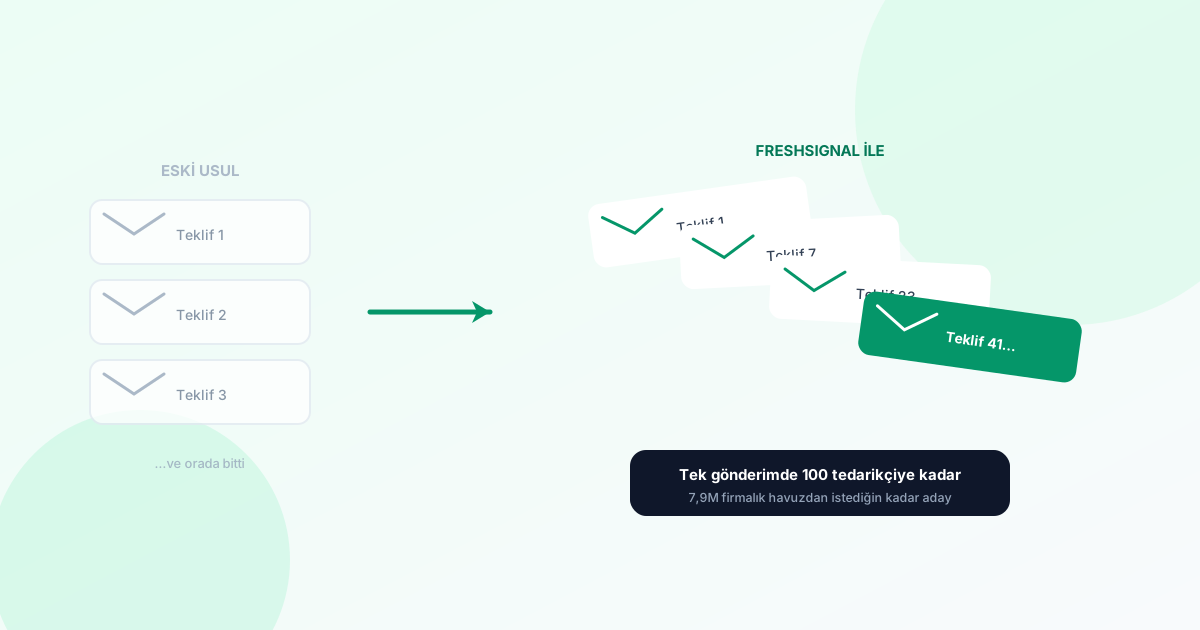
You know the scene. The workshop needs a replacement part for a machine, or the warehouse needs new racking, or packaging costs have jumped this year and it's time to find a new corrugated board supplier. The request goes up to the manager or the finance lead, and the answer is almost always the same: "Fine — but get me at least three quotes first." From that moment, days of graft begin: ring the supplier you already know, find a second one online, try to remember "who was it that sold these again?" for the third. Send emails, get no reply, chase by phone, hear "we'll come back to you", and walk into the meeting a week later with two and a half quotes.
In this article we put the famous three quotes rule on the table from start to finish: where it comes from, whether it's actually the law, why it exists, why it's so exhausting in practice and — most importantly — what the rule means once collecting quotes no longer has to be hard. Here's our thesis up front: the three quotes rule was invented for a world in which collecting quotes was difficult. When collecting quotes becomes easy, 3 stops being a ceiling and becomes a floor you clear without even noticing. FreshSignal's "Request a quote" tool does exactly that, and we'll walk through it step by step.
A familiar scene: "Get me three quotes"
Almost everyone who buys for an organisation grew up with this sentence. If you work in a school, an academy trust or a council, a purchase file rarely moves without evidence of quotes from several suppliers. If you're in the private sector, your company's procurement policy will demand three written quotes for anything above a spending threshold, and the accountant, internal audit or the external auditor will expect to see those three documents when they open the file. Even in a family business the owner says it on instinct: "Don't trust one price — ask two more places."
So where does this number three come from? Is it a magic number, a clause in an Act of Parliament, or a convention that settled in over decades? The answer is more interesting than you might think — and getting it right matters, because once you understand the rule's real purpose, it becomes obvious how to satisfy it better.
What is the three quotes rule and where does it come from?
In its plainest form the rule says: before buying goods or a service, collect price quotes from more than one supplier — in established practice, at least three — compare them, and base your decision on that comparison. The aim is to avoid the trap of mistaking one supplier's price for "the market price".
The rule has three main sources: public sector financial regulations and audit practice (very visible in the UK), companies' own internal procurement policies (especially in corporates and audited businesses), and close parallels abroad (Türkiye's direct procurement regime, for example). Let's look at each in turn, because the status of the number three is different in each.
The UK public sector: what do the rules actually say?
In the UK the clearest statement comes from the government's own schools procurement guidance on GOV.UK, which tells schools plainly to get at least 3 quotes from suppliers for low or medium value purchases. Councils and universities say much the same in their financial regulations and contract standing orders: above certain spend bands, three written quotes are required before an order can be placed.
Here's the subtlety worth understanding: these requirements do not come from the central public procurement statute — the Procurement Act 2023 does not set a "three quotes" figure for you. They come from each institution's own financial regulations and from audit culture. Auditors are used to seeing three quotes in the file, so institutions write that number into their own rules to stay safe at audit time. In other words, three quotes is the de facto standard across the UK public sector — but its source is institutional rules and audit practice, not primary legislation.
The private sector: the unwritten law
In the private sector the picture is more straightforward: here the three quotes requirement is not law at all, but an internal policy written into companies' own procurement procedures. It is, however, an extremely common policy. "At least three written quotes shall be obtained for purchases above the threshold" is practically a fixture of corporate procurement manuals.
Companies demand it for four reasons: to create competition (even suppliers who never see each other's bids price more sharply when they know they're competing), to validate the market price (a single quote tells you nothing about whether that price is reasonable), to prevent favouritism (reducing the risk of a buyer steering work to a friend), and to produce an audit trail (so that when external audit or internal control opens the file, the rationale for the decision is documented). The rule exists not just to get a better price, but to protect the company itself.
The same story in Türkiye
This rule isn't unique to the UK. In Türkiye, Article 22 of the Public Procurement Law (Law No. 4734) allows small-value "direct procurement" without a full tender, but requires the buying authority to carry out market price research first. Interestingly, the statute itself sets no numeric requirement — "at least three quotes" appears nowhere in the text, and written quotes aren't even mandatory. Yet three quotes has become the effective standard there too, entrenched through Court of Accounts audit practice, authorities' own internal directives and decades of convention.
So the pattern is identical in both markets: the big framework laws don't spell out the number three, but institutions' own rules and audit culture have made it the working standard. Since the FreshSignal database covers companies in both Türkiye and the United Kingdom, that parallel matters directly if you buy in either market — or both.
⚠️ Important note
Why does the rule exist? Let's take its logic seriously
It's easy to treat the three quotes rule as bureaucratic box-ticking. But the logic behind it is rock solid and deserves to be taken seriously:
- It creates competition. A supplier who knows their quote will be weighed against others prices more keenly. A supplier who knows they're the only one being asked has no reason whatsoever to sharpen their pencil.
- It validates the market price. A single price tells you nothing: is it expensive, cheap, normal? Only when several prices sit side by side does a range emerge and the idea of a "reasonable price" start to mean something.
- It prevents dependence on a single supplier. Always buying from the same firm is comfortable but makes you fragile: if they raise prices, miss deliveries or close down, you're stranded. Regularly collecting quotes keeps your alternatives warm.
- It makes favouritism harder. It ensures the decision rests on comparable documents rather than one person saying "I know this firm, they're fine."
- It produces evidence for audit. When an auditor, a business partner or a tax inspection asks tomorrow, "why did you buy this, at this price, from this firm?", the answer is already in the file.
So the problem isn't the rule itself. The problem is that in the era when the rule was invented, collecting quotes was hard work — and that hard work slowly hollowed the rule out into an empty formality.
Why the rule hurts in practice
A rule that looks flawless in theory wrestles with four big problems in the field:
- Collecting three quotes takes time. You have to find suppliers, phone them, email them, wait for replies, chase when replies don't come. Even for a single line item the process takes days, sometimes weeks. For urgent purchases that wait is a luxury, and the rule quietly gets skipped.
- The quotes always come from the same familiar suppliers. Because finding a new supplier is a job in itself, the three quotes are usually collected from the same three firms you've dealt with for years. That isn't competition — it's a ritual performed inside a small club. There may be dozens of firms in the market offering better prices, and you don't even know they exist.
- Three quotes don't reveal the market's real price range. Suppose fifty firms sell the product and prices spread across a wide band. The three firms you picked at random (or out of habit) may all cluster at the expensive end. You saw three prices, so you think you saw the market — when in fact you saw a small and probably biased sample.
- Process fatigue degrades decision quality. After two weeks of effort collecting three quotes, nobody says "let me ask five more firms." Exhaustion makes you accept the best of what's in front of you.
"Three quotes on paper": the rule's most common corruption
And then there's the rule's best-known disease: three quotes on paper only. In reality the winning supplier was decided long ago; the other two quotes are courtesy quotes collected purely to complete the file. Sometimes the intended supplier even arranges the "rival" quotes themselves — deliberately sourcing two higher-priced bids so their own looks cheap. The file contains three documents, but competition is nowhere to be found.
The purpose of the three quotes rule was never to have three pieces of paper in a file. It was to base the decision on a genuine market comparison. When the paper count becomes the goal, the rule dies and only the bureaucracy remains.
The root cause of this corruption is, again, the same: collecting quotes is hard. Because it's hard, people take shortcuts, and the shortcuts kill the spirit of the rule. Which brings us to the real question: what would happen if collecting quotes weren't hard?
Why 3 isn't enough: the real market price hides in more quotes
Let's run a simple thought experiment. Say a hundred firms in the market sell the product you need, with unit prices spread between £80 and £140. Out of habit you call three firms and receive quotes of £118, £124 and £131. You followed the rule, you picked "the cheapest": £118. But down at the bottom of the market there were firms selling at £85–£95, and you never knocked on their door. You followed the rule to the letter and still missed the market price.
As the number of quotes grows, two things happen at once. First, you see the market's real price range — you can only know whether your cheapest quote is genuinely cheap once your sample is wide enough. Second, your negotiating power grows: talking to a supplier with fifteen quotes in hand is a completely different experience from talking with three. "There are firms in the market doing this for X" stops being a bluff and becomes a statement backed by real data.
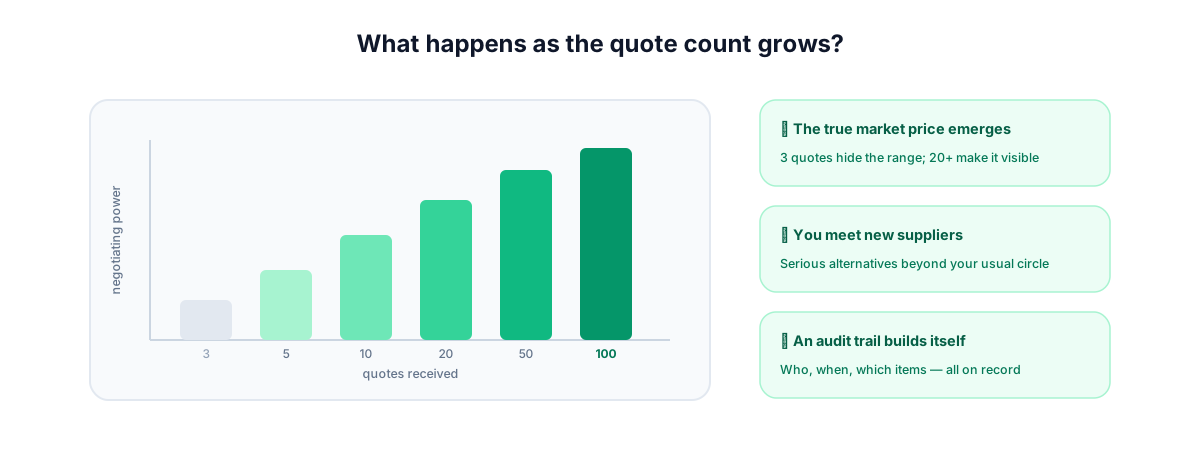
Price isn't the only dimension either: more quotes also raise your odds of finding a shorter lead time, better payment terms or a lower minimum order quantity. With three quotes, the chance of landing a strong option on every one of those dimensions is slim; with fifteen or twenty, it rises dramatically.
The old way vs the new way: how quote collection changes
So why does everyone stop at three? Because the fourth quote is expensive. The old way, every extra quote means finding another supplier, hunting down a phone number, explaining yourself and your requirement from scratch, sending an email, chasing the reply. Giving up after three isn't laziness — it's a rational cost calculation.
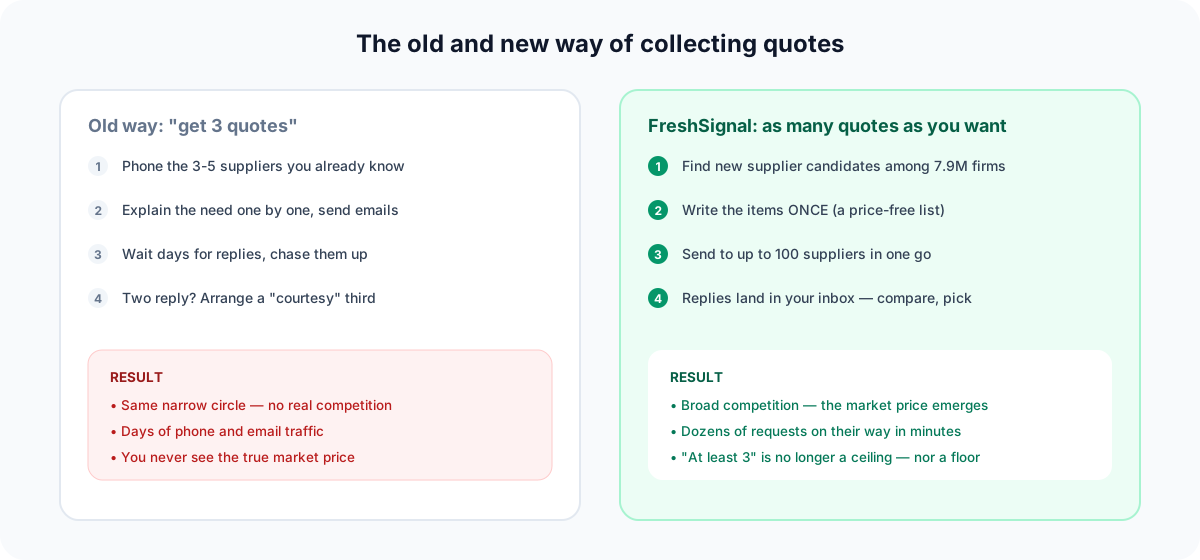
FreshSignal's "Request a quote" tool flips that cost equation. Finding candidate suppliers is no longer about leafing through directories: it's searching a database of 7.9 million companies across the United Kingdom and Türkiye with location and NACE sector filters. Requesting quotes is no longer about writing individual emails: you enter your line items once and reach up to 100 suppliers in a single send. When the marginal cost of one more quote approaches zero, the number three changes meaning: it's no longer a target you struggle to hit, but a threshold you pass without noticing.
| The old way | With FreshSignal | |
|---|---|---|
| Finding suppliers | Contacts, directories, web searches; days | Minutes, filtering 7.9M companies by location + NACE sector |
| Sending the request | A separate call / email per supplier | One form, up to 100 suppliers in a single send |
| Item list | Retyped by hand in every email | Picked from your saved purchase item catalogue |
| Replies | Scattered; hard to track who answered | Straight to your own inbox, under one subject |
| Audit trail | Buried across email folders | Dated record on the Quote Requests page |
| Typical number of quotes | 2–3 | As many as you like; 3 is just the floor |
Collecting quotes with FreshSignal, step by step
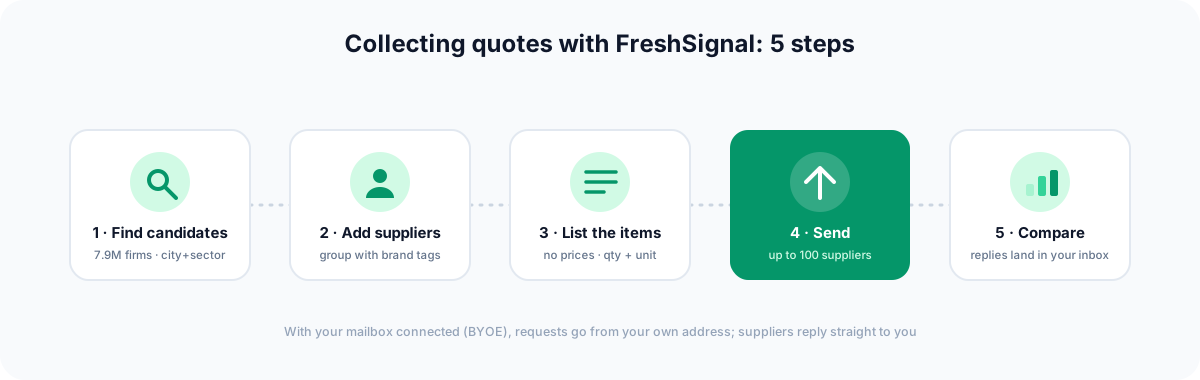
Now let's describe the process end to end, as if to someone who has never seen it. The tool lives in the Quotes section of the FreshSignal dashboard, on the "Request a quote" screen, and is included in every paid plan, Starter included. After signing in to the dashboard, you move through seven steps.
Step 1: Find candidate suppliers
Everything starts with finding the right suppliers — and this was the weakest link of the old way. In FreshSignal you search a database of 7.9 million companies (United Kingdom + Türkiye): the location filters let you say "keep it close to me", and the NACE sector filter lets you say "only show firms that actually do this work". Searches like "plastic injection moulding firms in the West Midlands" or "corrugated packaging manufacturers in Yorkshire" take seconds. Company pages show detected email and phone details, and a "Request quote" quick button on a company's page takes you straight to the request form with that firm's name pre-filled; to make it a recipient, you add its email on your Suppliers page — the next step. This is exactly where the vicious circle of the same three familiar firms breaks: you're now looking at the whole market, not your contact list.
Step 2: Add suppliers and group them by brand
You save the firms you want to ask on the Suppliers page: a name and an email address are enough. You can then tag and group suppliers by brand — say "corrugated packaging", "haulage", "electrical supplies". This grouping pays off later, because when sending a request you can choose "Pick by brand" and every supplier under that brand gets ticked in one click. A supplier pool you build once sits ready for every future purchase. One caveat: requests are not sent to suppliers without an email address — the system flags them clearly as "no email" — so enter the email carefully when you save them.
Step 3: Write the subject and the line items — and why there's no price field
The request form asks for three things: a Subject (e.g. "Q3 2026 corrugated box purchase"), a Message (a short text introducing yourself and your requirement) and the Requested items. Each line item has three parts: product/service description + quantity + unit. For example "Double-wall corrugated box 40x30x25 cm — 5,000 — units". You add rows with "+ Add item"; a request can hold up to 50 line items.
You'll notice something: there is no price field on the line items. That's not an omission — it's a deliberate design choice. When requesting a quote you don't state a price: the supplier sets the price. If you write your expected figure, one of two things happens: either the supplier anchors to your number and quotes higher than they otherwise would, or they find your number too low and never reply. Leaving the price entirely to the supplier is the only way to see the market's true price distribution — which was the whole point of this exercise.
Step 4: Use the purchase item catalogue
If there are products you buy regularly, there's no need to retype the item description every time. The "Search purchase items to add" box lets you search your saved purchase item catalogue and add an item in one click. Units are shared with the presets in your quote settings, so you don't write "units" in one request and "boxes" in the next and create confusion. As your catalogue grows, preparing a quote request takes seconds rather than minutes — which is exactly why "let's send one more wave" never feels like a chore.
Step 5: Up to 100 suppliers in one send — and the logic of waves
You pick recipients in two ways: ticking suppliers one by one on the "Recipients" list, or choosing "Pick by brand" — pick a brand and every supplier attached to it is ticked automatically. A single send reaches up to 100 suppliers. One hundred. The old way, you collected three quotes in a week; now you knock on a hundred doors with one click.
There's no limit on the number of sends: you can send as many as you like. That makes the wave strategy possible. In the first wave you send to, say, 60 suppliers around Greater London; if the replies don't satisfy you, you open a second wave to 80 firms in the Midlands and the North West. Each wave is its own send and is tracked separately. Sweeping the market layer by layer was unimaginable the old way; now it's a few minutes' work.
Step 6: Requests go from your own address — replies come straight to you
A critical detail: if you've connected your mailbox to FreshSignal, quote requests are sent from your own email address. The supplier sees you — your company, your name, your address — not an anonymous platform. That matters enormously for reply rates: firms quote for real buyers, not for robots they don't recognise. And the supplier replies directly to you — answers land in your own inbox, with no one in between. The suppression list is also checked before sending: an address that has said "don't email me" never receives a request.
Step 7: The Quote Requests history — a ready-made audit trail
All recipients of the same send are grouped as a single "request", and your history accumulates on the Quote Requests page: which subject, how many items, which recipients, on which date — all on record. Remember: one of the reasons the three quotes rule exists is to produce an audit trail. The old way, that trail was a scatter of correspondence across email folders; now the answer to "did we do market research for this purchase?" sits on one page, dated and tidy. Being able to tell an auditor, a partner or your own internal control "here — on 4 March we sent a quote request with these line items to 72 suppliers" is a far stronger piece of evidence than the classic three-sheet file.
How do you evaluate the replies?
Let's be honest here: incoming quotes reach you as emails, and you do the comparison — FreshSignal does not pour the replies into an automatic comparison table. Our practical suggestion is a simple grid: line items in the rows, responding suppliers in the columns; enter the unit price in each cell; add rows underneath for the total, lead time, payment terms and the quote's validity date. Even fifteen or twenty replies compare in half an hour with this table.
When evaluating, don't look only at the lowest number: lead time, payment terms, minimum order quantity and the confidence the supplier gives you are all part of the equation. This is where having plenty of quotes shines: you can see the cheapest, the fastest and the most flexible on payment separately, and choose by your priority. And remember — a rich set of quotes leaves you an up-to-date price map for future negotiations, even with the firms you didn't pick.
The other side of the coin: when a quote request lands on you
You've read this article through a buyer's eyes; but in the market everyone is buyer and seller at once. Tomorrow a quote request will land in your inbox too — perhaps one sent through FreshSignal. Then the roles flip: the firm that produces a fast, tidy, professional quote stands out from ten rivals. FreshSignal's quote builder exists for exactly that job; we walk through it step by step in the quote preparation guide. If you want to refresh the basics — what a quotation is and what it should contain — our article "What is a quotation and how do you prepare one?" is a good starting point. For the rest of our guides, browse the guides page.
Who is this for? Four concrete scenarios
- Manufacturers: Raw materials and semi-finished goods are the biggest line in the cost base. Steel sheet, granulate, chemicals, packaging — sending a wave to 50–100 suppliers for every periodic purchase shows you where the market price really sits, and compounds into serious savings over a year.
- Contractors and construction firms: Every site is a new purchase list: rebar, concrete, electrical supplies, subcontracted services. Location filters find suppliers near the site, the item catalogue rebuilds standard lists in seconds, and the project file gets a tidy audit trail.
- Cross-border buyers: If you trade between the UK and Türkiye, your selling price depends on your buying price. Shaving a few points off procurement cost is competitiveness in your export market — and because FreshSignal covers both countries, you search candidate suppliers and partners in either market from the same database.
- Schools, trusts, councils and corporates with financial regulations: For any organisation whose rules demand "at least three written quotes above the threshold", meeting the minimum now takes minutes rather than days — and the file records not three quotes, but thirty.
Pricing and plans
The "Request a quote" tool is available on every paid plan, including the $19-a-month Starter plan. That means the entire flow described in this article — searching 7.9 million companies, the supplier pool, brand grouping, 50-item requests, 100 recipients per send, unlimited sends, the Quote Requests history — is usable even on the entry-level plan. It isn't hard to see how the price advantage from a single purchase covers the monthly plan cost many times over. For current plan details, see the pricing page.
Summary: 3 is no longer a ceiling — it's a floor
Let's pull it together. The three quotes rule is not empty bureaucracy: it serves thoroughly sound aims — creating competition, validating the market price, preventing dependence and favouritism, leaving an audit trail. In the UK, the requirement comes from institutions' own financial regulations and contract standing orders — GOV.UK's schools guidance says it in so many words — rather than from the Procurement Act 2023; in the private sector, and in Türkiye, organisations' own rules and audit practice set the same minimum.
But the rule's weak spot was always the same: because collecting quotes was hard, three turned into a ceiling — and those three quotes usually came from the same narrow circle, sometimes only on paper. FreshSignal changes the equation: it finds candidate suppliers in minutes, delivers your request to up to 100 firms in a single send, brings replies straight to your inbox and keeps every send as a dated record. The rule still stands — you still meet whatever minimum your organisation or your regulations demand. What changes is this: 3 is no longer a ceiling you struggle to reach, but a floor you clear without noticing. You can send your first quote request from the dashboard today.
💡 Remember
Is getting at least three quotes a legal requirement?
In the UK, the three quotes requirement typically comes from your own organisation's rules rather than primary legislation: GOV.UK's schools procurement guidance tells schools to get at least 3 quotes for low and medium value purchases, and councils' and universities' financial regulations and contract standing orders require three written quotes above certain spend bands — but these are institutional rules, not the Procurement Act 2023. In Türkiye, the Public Procurement Law requires market price research for direct procurement but sets no numeric quote requirement; three quotes became the standard through audit practice and internal directives. In the private sector it comes entirely from companies' own procurement policies. In every case, follow your own organisation's rules; this is not legal advice.
How many suppliers can I send a quote request to at once with FreshSignal?
Up to 100 suppliers in a single send. There is no limit on the number of sends: if the replies fall short, you can send as many additional waves as you like. A single request can contain up to 50 line items.
Why is there no price field on the quote request form?
It's a deliberate design choice: the supplier sets the price. If you state an expected price, suppliers anchor to your figure and you never see the market's true price distribution. A line item carries only the product/service description, the quantity and the unit; pricing is left entirely to the supplier.
Where do incoming quotes arrive, and does FreshSignal compare them automatically?
If your mailbox is connected, requests go out from your own email address and suppliers reply directly to you, in your own inbox. FreshSignal does not pour replies into an automatic comparison table; you do the comparison. A practical method: a simple grid with line items in the rows and suppliers in the columns, recording unit price, total, lead time and payment terms.
Where do I find the suppliers to ask?
You search FreshSignal's database of 7.9 million companies across the United Kingdom and Türkiye using location and NACE sector filters. Company pages show detected email and phone details; you can add a firm via the "Request a quote" quick button on its page or from the Suppliers page with a name + email, then group suppliers by brand. Requests are not sent to suppliers without an email address.
Which plans include this tool?
The "Request a quote" tool is available on every paid plan, including the $19-a-month Starter plan. Current details are on the pricing page.