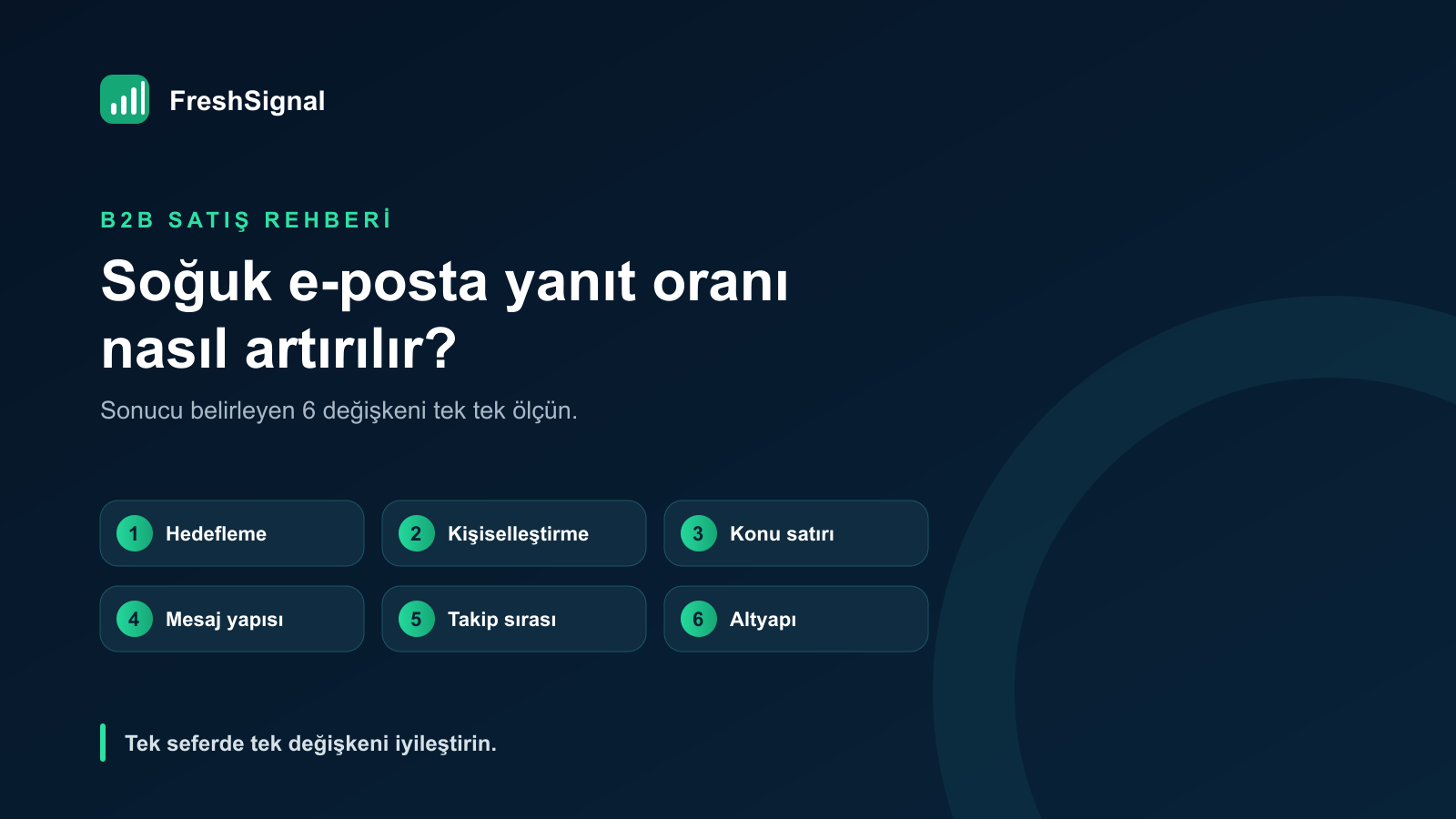
When a cold email campaign gets few replies, the instinct is often to rewrite the copy. But the copy may not be the real problem: you may be contacting the wrong company, the wrong role, with a weak subject line or an untrustworthy sending pattern. Reply rate is the combined result of six connected variables.
This guide helps you diagnose targeting, personalisation, subject line, message structure, follow-up and sending infrastructure. It does not promise a universal benchmark: product, market, brand awareness and offer strength all affect performance. The goal is to replace guesswork with controlled improvement.
ℹ️ Define the metric first
1. Targeting: great copy cannot rescue the wrong audience
Check three layers: the right company by sector, location, size and need; the right person or team; and the right moment, such as investment, hiring, expansion or another current company signal.
| Weak approach | Stronger approach |
|---|---|
| All manufacturers in the UK | Mid-sized Midlands manufacturers showing an export or expansion signal |
| One message for founders, procurement and operations | A distinct problem, outcome and CTA for each role |
| Send an old list immediately | Recheck company, role and email data before launch |
2. Personalisation: explain why them, and why now
A first-name field is not enough. Useful personalisation connects a verifiable company event, product, market or operational context to the reason for your message. Never invent familiarity or use empty compliments.
3. Subject line: set the right expectation
Keep the subject short, specific and faithful to the message. Fake “Re:”, manufactured urgency and exaggerated claims may win a click but damage trust and positive replies.
A quick question about your Birmingham site[Company]’s new export marketSupplier research at [Company]
4. Message structure: observation, value and one easy question
Answer three questions quickly: why are you writing to me, what is in it for me, and what do you want me to do? A practical structure is relevant observation → business problem → concrete value → one low-friction CTA. About 60–120 words is usually enough for a first touch.
5. Follow-up: add a new reason, not the same message
Silence is not always rejection. Each follow-up should add a useful angle: a market observation, relevant example, proof point or a polite close. Stop the sequence immediately on a reply, unsubscribe, complaint or bounce.
| Step | Purpose | Content idea |
|---|---|---|
| First touch | Establish relevance | Observation + value + one question |
| Follow-up 1 | Reframe the value | New company or market context |
| Follow-up 2 | Reduce perceived risk | Relevant case or sample output |
| Close | Remove pressure | Ask whether this is a current priority |
6. Timing and trustworthy infrastructure
Treat common send-time advice as a hypothesis, not a law. Test comparable windows in the recipient’s local time. Before timing, fix deliverability: configure SPF, DKIM and DMARC, increase volume gradually, suppress bounces and opt-outs, and follow Google’s current email sender guidelines.
Use metrics to locate the problem
| Observation | Inspect first | First test |
|---|---|---|
| High bounce rate | List freshness and address quality | Send to a smaller, freshly checked segment |
| Delivered but few opens | Sender identity, subject and deliverability | Change only the subject line |
| Opens but few replies | Target role, opening, value and CTA | Test the role or CTA |
| Replies but few positive replies | ICP and offer-market fit | Build a narrower need-based segment |
Four rules for a useful A/B test
- Change one variable at a time.
- Use comparable audiences.
- Wait for enough delivered messages before deciding.
- Measure positive replies separately from opens and total replies.
💡 A practical FreshSignal starting plan
Conclusion: reply rate is a system, not a copy trick
More replies do not automatically require more email. A narrower audience, credible context, shorter message and measured follow-up are often the better start. FreshSignal helps you build the target list, review company signals and launch a follow-up sequence from the same workflow.
What is a good cold email reply rate?
There is no universal number. Product, price, market, brand, role and the definition of a reply all affect it. Compare against your own previous campaign in the same segment and track positive replies and meetings separately.
Should I change the subject line or the target list first?
If delivery is healthy but opens are weak, inspect the subject and sender identity. If opens are healthy but replies are weak, inspect the target role, value proposition and CTA. An irrelevant list cannot be fixed by copy alone.
How long should a cold email be?
There is no hard limit, but a first touch should be easy to read on a phone. Roughly 60–120 words is often enough for an observation, value proposition and one question.
How many follow-ups should I send?
Prioritise recipient experience over a fixed count. Each follow-up should add value or context, and the sequence must stop on reply, opt-out, complaint or bounce.